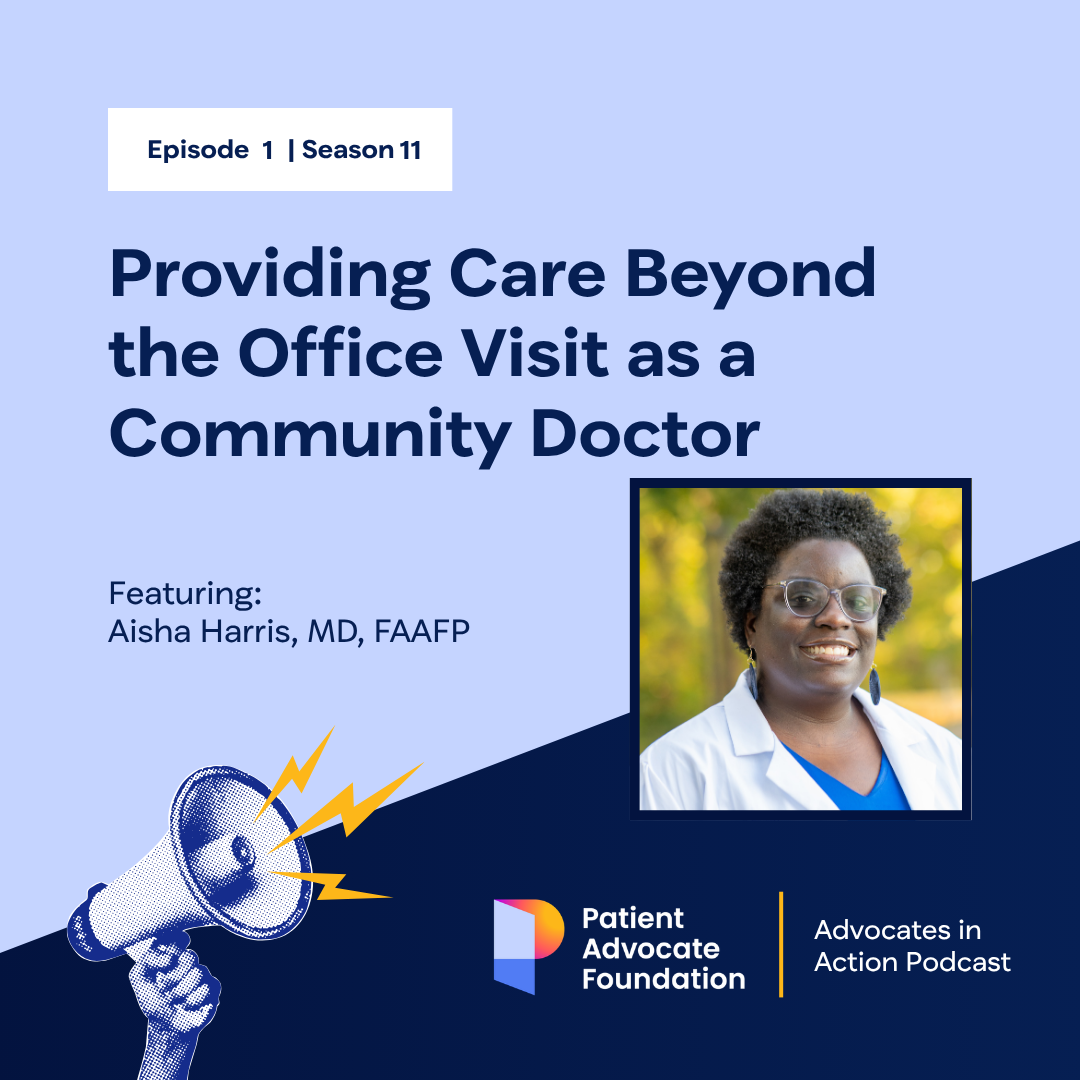
Episode Transcript
[00:00:03] Speaker A: The traditional health system doesn't always prioritize the patient. I wanted to have more direct access, communication, direct care with patients without the patient was feeling burdened by trying to see me and I was feeling burdened by trying to do all these things in a small time frame. The main motivation to opening my clinic was giving both me and the patient a better experience when it came to the patient appointment and the patient doctor relationship. By creating my clinic and building the first membership based clinic in Flint, I was able to give people an innovative way to actually have a real relationship with your doctor and feel like someone's sitting there listening to you and you're feeling heard and there's actually a genuine relationship and not like it's a quick convenience store type of experience.
[00:00:44] Speaker B: Welcome to another episode of Advocates in Action, a podcast created by the Patient Advocate Foundation, a nonprofit that helps promote equitable access to affordable, quality healthcare through providing case management services, financial assistance, and patient education and advocacy tools to people living with chronic, life threatening and debilitating illnesses. I'm your host, Ashley Freeman, manager of stakeholder outreach and engagement. Thank you so much Dr. Harris for being able to join me today. I would love to start the conversation with a little introduction of yourself. Can you share a bit about what you do and what your day to day looks like as a physician?
[00:01:30] Speaker A: Thank you Ashley for having me. I'll say I am a family medicine doctor in Flint, Michigan, which is where I'm from. And so after all of my training I went home to practice medicine in my community. I currently own my own clinic called Harris Family Health in Flint and it is a unique clinic in the sense that it is a membership based clinic. And so I don't bill or accept any health insurance, but I provide comprehensive, full, genuine care to my patients through an affordable membership that allows them to have more time with their doctor and more access and get to prioritize their health a lot better.
[00:02:02] Speaker B: I love that you returned home after, I'm guessing going to school in different states and traveling. What put it on your heart to return home to serve your, your hometown community?
[00:02:16] Speaker A: I always wanted to come home, but I was open to kind of staying and being wherever I trained. And so I did medical school in D.C. and that was, that was a really cool experience. I did residency in Chicago and and I honestly always felt like a transplant. And so I'm a community doctor and so in all those places I was always doing community work, I was always doing outreach work. But there's something about coming home and understanding the community in a More in depth way that is so valuable to me. I didn't want to use my skills to help other people in other places that I didn't fully understand. I really wanted to help the community that raised me. And during medical school, unfortunately, was when the water crisis happened in Flint. And I knew it months and months before everyone else because I was going home during break and things and that kind of fine tuned my desire to go back home because I saw how people saw Flint and I saw all the negative things that they were saying. And I'm like, this is my city that like it's so much going on, there's so many positive things happening. I just want to be part of that story that showed how beautiful and amazing Flint was. And I wanted to apply my skills to a place that really valued me and really loved me and also just wanted to be home with my family. I didn't want to be just working and just being a doctor in a community somewhere. I wanted to know that working, working as a doctor was a small part my day to day. And being with my family, being able to do things in evenings and weekends and traveling with them and just seeing them on a regular basis was really valuable because I understood the power of social connection and mental health.
[00:03:44] Speaker B: I love that. I love that you said being a part of the story, right, this story of re envisioning or redefining what and who Flint is to the rest of the world that doesn't know the fabric, right and the interconnectedness of the community. So I love that you for sharing and what does it currently look like for you? I know you said you're a community doctor, so explain what a community doctor means.
[00:04:14] Speaker A: I love being a community doctor. So one of the reasons that I chose family medicine, as far as being a doctor to adults and children and being trained to deliver babies, is I wanted to be able to be a resource to everybody. I wanted someone who had a headache and someone who had a foot pain to be able to say, yes, Dr. Harris can help me because she's a family doctor and she knows things from head to toe. But one of the amazing things about being a community doctor is as much as I know more about my patients because they're like directly my patients, I also understand the challenges and concerns that my community has. And so being a community doctor, I pride myself on being available to the community in different ways. Whether it's health education work, health policy work, public health work. I really want them to feel like they don't have to be a patient of Dr. Harris's to understand my passion for helping the community and trying to make people a little bit healthier. Granted, when I'm doing health education, it's usually general. I can't be too specific because I don't know the direct concerns of everybody as much as I know my own patients. But there's some valuable information when it comes to addressing health literacy more directly and more intentionally and consistently. And so right now, I love being able to be on a short list for my patients and my community to be able to say, oh, you have a topic that you want someone to talk about? Dr. Harris can probably talk about that, or at least she knows someone who can talk about it. But usually is a general enough topic that I do know enough about it to talk about it. And I pride myself on not only my patients, but also my community understanding their own health concerns in a digestible way. And so the same way that I'm telling my patients how something's messing up in their body or how medication works or something that they may need, I'm explaining it as simply to my community, too. And so I think people really value that approach and like that. I live in the community that I work in because not a lot of doctors around here live in the community they work in. So I know the concerns that are going on with politics, with transportation, with consumers, whatever it may be like. I'm dealing with those problems, too, But I really just wanted to be a resource. And on a regular basis, monthly, I'm usually talking somewhere in the Flint community about some health concern. I recently was doing the Women's Health Talk breakfast that I was invited to. I've done things about children's health, teens health, men's health, cancer things, diabetes, high blood pressure. Like, the list goes on and on about the topics that I can talk about. And it's not so much that I'm, like, prepared to talk about those all the time. It's more so that my training has allowed me to have that experience and knowledge on a regular basis as far as being able to present it to people. But also I pride myself on being very approachable, where people who don't know me are saying, like, hey, Dr. Harris, I heard that you can speak to people about things, and that's just broadening my connection across the community. And I don't think that I would be such an impactful community doctor if I didn't come home. There's a lot of value in being a homegrown doctor that is from here that I understand the things that were happening when I was younger. Granted, I wasn't paying attention to them fully because I was a kid, but I understand the foundation of the city and the history of the city. And that makes being a community doctor so much more amazing because they know I'm not just jumping in and having no clue. Like, no, I understand what you're dealing with because I dealt with it too, and now I'm here to help. So I just love being a community doctor. I'm doing exactly what I thought I would be doing and hope that I would be doing when I was a medical student. It's just amazing to see it come to fruition as far as being able to actually walk the walk and talk the talk, as far as being a community doctor that the community actually appreciates and uses me as a resource on a regular basis.
[00:07:41] Speaker B: Thank you for breaking that down. For people who maybe weren't familiar with that term before, because when you were explaining, sounded like to me that your work is so much bigger than four walls of your office. And we always talk about, oh, patients live so much life outside of the four walls of when they're coming in to see their doctor. It's like only this 10% and this is all your doctor knows about you and all they see of you. But you're like, no, actually, like, I see that 10% when they're in the office, but I also see them outside of this because I go to church with them or I'm at the grocery store with them or I'm at them, or I know their child because my niece goes to school with them. So that, ooh, when you were describing it, I could just see it in my head, that homegrown doctor and making yourself approachable. Because we all know that there can sometimes be hierarchy. And we've heard of the white coat syndrome and people not feeling comfortable to ask questions of their doctor or to be vulnerable or what does. There's so many sessions about what does building trust with your doctor look like?
It seems like you've been able to build trust and achieve vulnerability and achieve connections without it feeling forced. Because it is. And you use this in your introduction, genuine care.
So, yeah, thank you for explaining that for us. So what are some of the challenges that your patients are facing right now? So whether it's accessibility or things that you do, you see in your office, or maybe it is policy related,
[00:09:24] Speaker A: that's. That's a deep question. I'll talk about the top three and I'll try and talk about them in a short way, but I'll say mental health, lifestyle choices and kidney disease are probably the top things that I'm consistently concerned about. And it changes from season to season. And obviously I only see a small piece of the community, so there, there might be more problems going on. And I'm not part of a health system, so I don't have a bunch of data. Some of the stuff is just based on what I've observed and what I've read and the people that I've interacted with. But I'll say from even my cohort of patients and the people I know in the community, mental health, lifestyle and their kidney disease are probably the things that are making the long term impact. I'll start with mental health in the sense that a lot of people are stressed. Chronic stress is a thing that we don't talk about enough when it comes to medicine and how it just stacks on to different experiences. And sometimes people are at a low stress point, sometimes people are constantly at a high stress point and how that impacts someone's health. Kind of know that if you're stressed, your blood pressure might be a little high, but it's also the hidden inflammation that comes with chronic stress and the idea that that type of thing can increase your risk of heart disease and strokes and diabetes and even cancer. On the other piece of mental health is the depression anxiety piece. I think the pandemic unraveled a lot of people's mental health in a sense that they didn't realize that they had a mental health disorder until all their coping mechanisms were taken away. And that's on top of the fact that with Flint, a lot of our younger adults, them being exposed to the water crisis made their mental health and behavioral health concerns skyrocket. And so our education system is getting really stressed by learning disorders and mental health disorders that were exacerbated by the water crisis. A lot of them are young adults trying to get jobs and depending on what their education experience and employment experience is, they only have so many opportunities. I'll say lifestyle choices in the sense that Flint is kind of a food desert. We don't have that many grocery stores. And even where I live, which is a pretty dense neighborhood in the city, it still is not that close to a lot of grocery stores in the sense that like, it probably would be like a 30 minute walk if I really wanted to walk to one. Outside of just the choices that people are making, a grocery store, as far as getting there, people also aren't making great choices with their lifestyle as far as their nutrition as Far as the physical activity, some of that is financial, where it's hard to get a gym membership. It's hard to make those choices when you're working all the time. Their work is not making it easy for them to prioritize their health. And so they're having certain lifestyles that are defaulted to the type of work that they do. It could be long hours, it could be night shifts. It could be having multiple jobs. It could be trying to balance school and the family and work. It could be a lot of things. And so I think people aren't able to make the great greatest lifestyle choices because it's an intentional move to prioritize your health. And unfortunately for a lot of people, their health is not on the top list because they got to pay rent, they got to get their mortgage set, they got to get their groceries, the kids need daycare, the kids need medicine. They need medicine, they gotta take care of their parents. Whatever it may be, people personally do put their health on a lower list. The last thing I'll talk about is kidney disease. It frustrates me on a regular basis how many people have kidney disease and don't know they have it. There's five stages to kidney disease. The fifth stage is dialysis. A lot of cities are growing in their dialysis centers being built and stuff. Most kidney labs do not highlight kidney disease until stage three.
So the idea that people are not getting that, like, high, low, or, like, abnormal indication on their labs where, like, it's like, red and like, oh, my gosh, you should do something about this lab.
The fact that that's not showing up till stage three, and a lot of my counterparts are not speaking to their patients about kidney disease until it's stage three. Because the lab didn't say that it was abnormal. Like, I talked to my patients about kidney disease at stage one. Top reasons for kidney disease is high blood pressure and diabetes. And then you probably could put high cholesterol on there, too. And so I think that there's a lot more people walking around with kidney disease that don't know it. And unfortunately for a lot of my new patients that I see, I don't trust when they're like, oh, yeah, they said my labs are normal. Nothing against the patient. Like, they're just saying what the doctor said. But I've had way too many of my counterparts not tell a patient that they had kidney disease and me be the one that has to be the bearer of bad news, saying like, hey, you do have kidney disease. It's chronic. Have you Ever had it worked up. I see so many people who are in their 30s, 40s, 50s, 60s, who had kidney disease for years based on, like, old records and old labs, but never knew it. And so they weren't as motivated to address the thing that was probably making it, like, really bad as far as their blood pressure, their diabetes or cholesterol, because they thought they were fine. So that's always a little bit tough to have to address kidney disorders because someone could have been preventing it from getting worse or possibly reversing it if it was really, really early stage. So mental health, lifestyle choices, and kidney disease are probably the top things that I'm regularly concerned with in my community.
[00:14:12] Speaker B: What does care look like at your practice when it comes to empowering your patients? Right, because you just mentioned there are some patients that you have that are coming from other practices where they weren't notified about certain things that have been on their records for years. Right. Or like you mentioned, the workload, being caregivers, all of the roles and responsibilities that they have when they enter your doors. What is your goal for them? What does that partnership look like between you and your patients to now help empower them? Because now they're in your doors and now you feel a sense of responsibility for them. But how do you help them navigate all of these things?
[00:15:01] Speaker A: It's exactly what you had said. As far as a partnership, there's two pieces. So if someone comes in with prior problems, prior concerns, prior kind of labs and things, my goal is for them to understand what's happened in the past, but also equip them with the understanding that we're starting from here with the future steps. There's some unfortunate things that have happened, whether it's personality clashes, whether it's financial situations where there's access difficulties. But now, in this moment, with me as their doctor, we're going to move forward and help them navigate the health system more intentionally and more confidently. So I always want my patients to understand what's going on. So I really prioritize health literacy. I say before they can even say it, that if you don't understand something, please let me know. If you hit the car door, if you hit your house door and you had like a brain fart of, like, something that I said, please tell me, because I want to explain it in a different way. I want to make sure that you know what's going on, because you are the one that's living your life. It's their story. And so I try and make people feel like they have more Autonomy with their story, health choices, that it's not just like the doctor said this, so I got to do this. Every person is different. At the end of the day, I can only be a resource. And so it is up to the person to decide what their next steps are. But I want them to make an informed decision. Sometimes it's a decision that I agree with. Sometimes it's a decision that I wish they would kind of rethink. But at the same time, I want them to have all the resources and all the knowledge to make a decision that's right for them at that time. Now, I might repeat things in the future and like, still recommend shifts and other other therapies in the future, but I want them to know that the decision they made is their decision, and they made it in the most informed way. I also think that it's really important to have safe spaces. People come to my clinic with old problems, a certain history, medications, surgeries, whatever it may be. But from here on out, they also may have new problems.
And so I also want my patients to understand that they can bring up new problems, that we're going to talk about them, that we're going to work them up and figure them out, and that the path forward is still going to be the healthiest path forward with the most resources available. Because I don't believe that it is a great primary care experience. If a patient doesn't feel like they can talk to their doctor about new problems, they can bring up something that's concerning that they're confused about. Pride myself on trying to establish a space where people can tmi me so where they can tell me too much information, and then we can decide what we're going to do in that moment and what the next steps may be. The last thing I'll say is, when it comes to my patient kind of partnerships and stuff, I might not always be their doctor. They go to anywhere else. They know what their care is about, they know what's happened in the past. They don't go to a hospital and not know what medications they're on and all those things. I enjoy the patient care. It is a challenge to establish that type of relationship and that type of partnership. But I think it's really important for patients to have something that they feel that is a real positive in their health journey. Because now all of my patients are really healthy people. Some of them have multiple problems, and each and every one of them, I want them to feel that they are getting the best care, that they are being able to advocate for themselves and speak up and have some clarity about the next steps.
[00:18:07] Speaker B: Sounds to me that you get very creative in your approaches and everything's very personalized for each of your patients. So what inspired you to start your own practice?
[00:18:22] Speaker A: The biggest two things were I wanted to be able to make a bigger impact with my patients. And I felt like the system that I was working in was very restrictive and demanding in different spaces that weren't necessarily patient focused. And so I wanted to be able to close those health disparity gaps, improve access, have stronger relationships with my patients, knowing that what I was doing was going to make them healthier, make them live longer, make them have a higher quality of life. The traditional health system doesn't always prioritize the patient. I wanted to have more direct access, more direct communication, more direct care with patients without feeling the patient was feeling burdened by trying to see me. And I was feeling burdened by trying to like do all these things in a small time frame. And so the main motivation to opening our clinic was giving both me and the patient a better experience when it came to the patient appointment in the patient doctor relationship. By creating my clinic and building the first membership based clinic in Flint, I was able to give people an innovative way to actually have a real relationship with your doctor and feel like you aren't being rushed, it's not difficult to get in that someone's sitting there listening to you and you're feeling heard and there's actually a genuine relationship and not like just peeling like a number on the wall. I feel like it's a quick convenience store type of experience. I wanted to have valuable relationships and communication with my patients and feel like I was giving all without feeling like I was getting squeezed at the same time because it was, it was very suffocating in the traditional system. And so now I feel like I can breathe, I feel like I can be a great doctor to my patients. I was a great doctor before. I wasn't saying like I wasn't giving great care before, but it was a challenge in that system to give the quality care consistently with all the time restraints, with all the barriers, with all the quote, unquote, patient focused things that I felt weren't fully patient focused. They're more business focused and trying to not fully see patients as humans, but more see them as just in and out situations. And that's not how I want to practice medicine.
[00:20:15] Speaker B: And I know that starting your own practice gave you a lot of liberties and freedom to be able to do that. I loved what you said, now you feel like you can breathe. However, we are in this time when there are changes to the Affordable Care Act. And so even though you might not have the same restrictions and challenges as before, being in the prior system, what are some challenges that you're seeing today, whether for you and your practice or for your patients and how they're being impacted by these changes?
[00:20:47] Speaker A: The patient impact is the biggest. I think what's happening with the Affordable Care act, with Medicaid, with how people access health, is very kind of devastating. I know that's a strong word, but I think people don't see the consequences of the choices that people are making around healthcare. And I don't think the intention behind the healthcare system is as patient focused as it's supposed to be. In a sense that it's a lot of money talk, premiums and deductibles and bills and pharmaceutical companies charging certain amounts. The more people focus on the money, the less people focus on the patients. And the fact that people are humans, the fact that people are fragile, the fact that we only have one life to live and our health is a really important piece of it. And so seeing what's happening with the policies, it doesn't directly impact my clinic because I don't deal with kind of the regulations of insurance and stuff like that, but majority of patients still have insurance.
And so when I'm recommending certain things, if their insurance or if their policy kind of shifts how we can practice medicine, then I'm going to have to make a different medication recommendation. I'm going to have to send them to a different doctor that may have the same skills, but also may not have the same skills of the person that I wanted to recommend. Whether it's bedside manner and personality or actual medical knowledge and surgical skills, it makes you have to balance more things. It's the art of medicine that gets into the conversation a little bit more. And what people don't see is when there's a financial strain on patients, they just don't go to the doctor. They just don't pick up their medicines. They make other choices outside of their health in order to prioritize that moment in that day. And so if someone doesn't pick up their medicine, if they don't go to the doctor, they may not have any complications immediately, but they may have a complication the next week or a month from now or a year from now because of that decreased access. And so that's what I'm more afraid of with all the things happening, is that the conversation is less about how it's impacting humans and patients and more about kind of the bottom line and the financial situation.
I just think that we do a lot of things in this country, but we don't do health care very genuinely and intentionally as far as focusing on the patients and the people in the communities. As much as we're a powerhouse when it comes to modern medicine and making all these innovative things and great research and all this stuff, it's not accessible to a lot of our patients in our community because the affordability aspect is stifling their even thought of like even considering a medicine or considering a surgery or even trying to go to a primary care doctor or doctor in general. So I just think it's just really challenging for the patients to know what they should do because they know that they should prioritize their health. But the system makes it very difficult. And then when health choices are difficult, people just opt to just not even think about it and not deal with it. And that's how we die early. That's how we have more complications, that's how people have detrimental things that can't be reversed just because they had a blip in their access for that moment or that year or multiple years, whatever it may be. It's just difficult to see how much we're trying to be preventative. But this right now with all the policies is not preventative. It's going to be detrimental to a lot of people.
[00:23:44] Speaker B: With all that you just said, how do you stay in this work? What keeps you motivated to do this work? Knowing all of the potential long term effects that you just mentioned, like the fact that yes, this is impacting people today, but the impact that it'll have even years from now, the decisions that are being made today, how do you keep coming to this work with all of your heart, with all of your passion, knowing all that you're running up against and all that your patients are running up against?
[00:24:15] Speaker A: I'll say first that I focus on the small wins in medicine. Not every patient appointment is going to be a great conversation. Not everything's going to be like this has gone away, this is feeling better. Some things are going to be tough conversations. The wins always come very locally. I'll say I'm doing community things. I appreciate when people are informed enough to go to the doctor, informed enough to take that next step in their health care. But that's the reactive space. I try and keep my reactive space as positive as possible. So that way it keeps my mental health and my motivation consistent and Established. So local is my happy place when it comes to medicine. When I look at state and I look at federal stuff, that's where I get my motivation to be more of an advocate, to do more policy stuff. I do local policy and advocacy stuff, but most things that happen are locally, are happening on the state and federal level. So I try and take my voice into different spaces, take my experiences, take my patient stories, take all those things into these different spaces, or to advocate for my patients and be more proactive and upstream when it comes to my impact. If I don't say something, if I don't do something, all these things that may pass. I would feel really sad if I didn't say that at least like stood up for what I believed in. I want to at least know that when the time came I voted for something, I talked to legislators on state and federal level. I did my part to make that not feel as heavy of a fail if it doesn't work out. But also if it does work out, then I feel like I've been involved in some deep change. But it's hard to balance. It's a roller coaster of it emotions when it comes to the health system and how I personally have interacted with the health system, but also how professionally interacted with the health system. Because once you're in the health system as a nurse, a doctor, a pa, an mp, a front desk person, whoever it may be like, once you're in the health system, you see how messy and complex it is. And so trying to make that a little bit better every single day is a challenge. But it's worth it to know that it could save people's lives. That's the main thing that I want people to have long, quality lives. And if I can do whatever I can in a professional sense to advocate for those spaces, I will. It's exhausting, it's not easy. And that's where those little wins locally and with my patients makes a difference. Because when you're fighting against people who don't want to change stuff and you don't get why they don't want to help humans be healthier, it's really frustrating. But I really want to help people in the end and I really want to be part of that change. And I'm going to keep doing it, even if it disappoints sometimes, because I do get victories. I do see the win here and there. And it's worth it to keep pushing forward so that way people can live better lives.
[00:26:38] Speaker B: The small local joys you're Focusing on what you can control, what's out of your control, you just release it.
And lastly, for providers who are listening to this and are maybe identifying with where you were when you said you were feeling like you were stifled on what your possibilities of being able to help your patients were, what advice would you give to them if they want to be able to get on this other side and provide more genuine care?
[00:27:12] Speaker A: First, I really think that people who are doctors and looking at the space that they're in and not really enjoying it as much, I think it's important to look at the big picture, to look at the type of doctor that you want to be and where you're at and compare and contrast those. But I also think that when it comes to being a doctor, knowing that your medical license is yours, like taking ownership of that is really important because you can work in a lot of spaces with that license. It doesn't have to be the space that you're in. But I think it's really important to take hold of your license and say that this is mine, I earned this, I went to school, I did all the testing, like this is mine and be proud of that journey. And lastly, I'll say being a doctor is a great honor. Like a lot of people respect being a doctor, it comes with a lot of challenges, which is why a lot of people are having difficulties in their different workspaces. But I think that we don't get trained to think outside the box. I think when we are trained, we are trained to be employed, we're trained to work in a health system, we're trained to see patients 100% of the time. All these things are what we're trained to do. And I think if someone is able to be proud of their license, think about the big picture of what type of doctor they want to be. Whether it's in that season or long term. What do you think that your day to day should like look like then? I think that people can be more creative on how they practice medicine. I didn't realize until I started my clinic that I love non clinical work. Like I'm working for a medical school. I'm doing health policy and public health work, I'm doing more community work. All these things that I didn't actually think that I was going to be able to fully tap into or even thought that was really an interest. The only thing I'm not really interested in is research. So I just consistently kind of avoid that. But there are people who also love that space. And so I didn't realize some of the things that I enjoyed as a doctor in those spaces until I actually looked at it from a broader perspective and started saying yes to stuff that I thought that wasn't necessarily me, but actually is kind of me and actually turns out that I really enjoyed.
[00:29:04] Speaker B: Well, thank you so much for ending on such a high note. Anything else that you wanted to share?
[00:29:13] Speaker A: I hope that patients who listen to this will feel like they can empower themselves a little bit more in how they pursue their medical information and do their preventative care and primary care kind of work. So I want patients to be more motivated, but I also want doctors to feel motivated too, to diversify how they practice medicine and feel empowered enough to ask themselves the right questions and reflect on what type of doctor they actually want to be. We tend to be more creative in how we approach things and put ourselves on the list to actually jump into new spaces because everything is health. All spaces need doctors because 80% of someone's health is outside the health system. So we need more doctors in the other piece of schooling.
[00:29:51] Speaker B: I'm Ashley Freeman and thanks for listening to this episode of Advocates in Action. If you haven't yet, please subscribe, review and share this podcast. Your support is greatly appreciated. We enjoy connecting with our listeners, so please visit our website for show notes, resources, and ways to engage with us on social media. Thanks for listening.