Episode Transcript
[00:00:03] Speaker A: Embracing disability as a creative lens, problem solving lens to look at the world. There's this concept that I love called universal design.
Let's look at the world and try to build it to be inclusive for the widest swath of people.
We have to think outside of the box, and people with disabilities are used to doing that and they can help help us all elevate society and the way we do things. Because if we live long enough, we're all going to be disabled.
It's just a fact.
And we're all interdependent. We may want to believe that we're independent and we don't need anybody, but we all will. It's just a fact of life.
[00:00:48] Speaker B: Welcome to another episode of Advocates in Action, a podcast creating created by the Patient Advocate Foundation, a nonprofit that helps promote equitable access to affordable, quality health care through providing case management services, financial assistance, and patient education and advocacy tools to people living with chronic, life threatening and debilitating illnesses. I'm your host, Ashley Freeman, Manager of Stakeholder Outreach and Engagement. And welcome to season 10 where we get the opportunity to discuss what happens to patient care when equity and inclusion in health care are under threat. I'll be joined by some guests who can provide some hope to the troubling trends we are witnessing, including shifts in health policy, reduction of funding, limits on research priorities, and changes in clinical practices that threaten to dismantle home hard earned gains in health equity. Thank you so much Christy for being here with me as we are wrapping up our 10th season of Advocates in Action where we are focused on equity. So I would love for you to open up and tell our listeners your name, your background, and a little bit about the work that you do.
[00:02:07] Speaker A: Well, thank you, Ashley. I'm so pleased to be here.
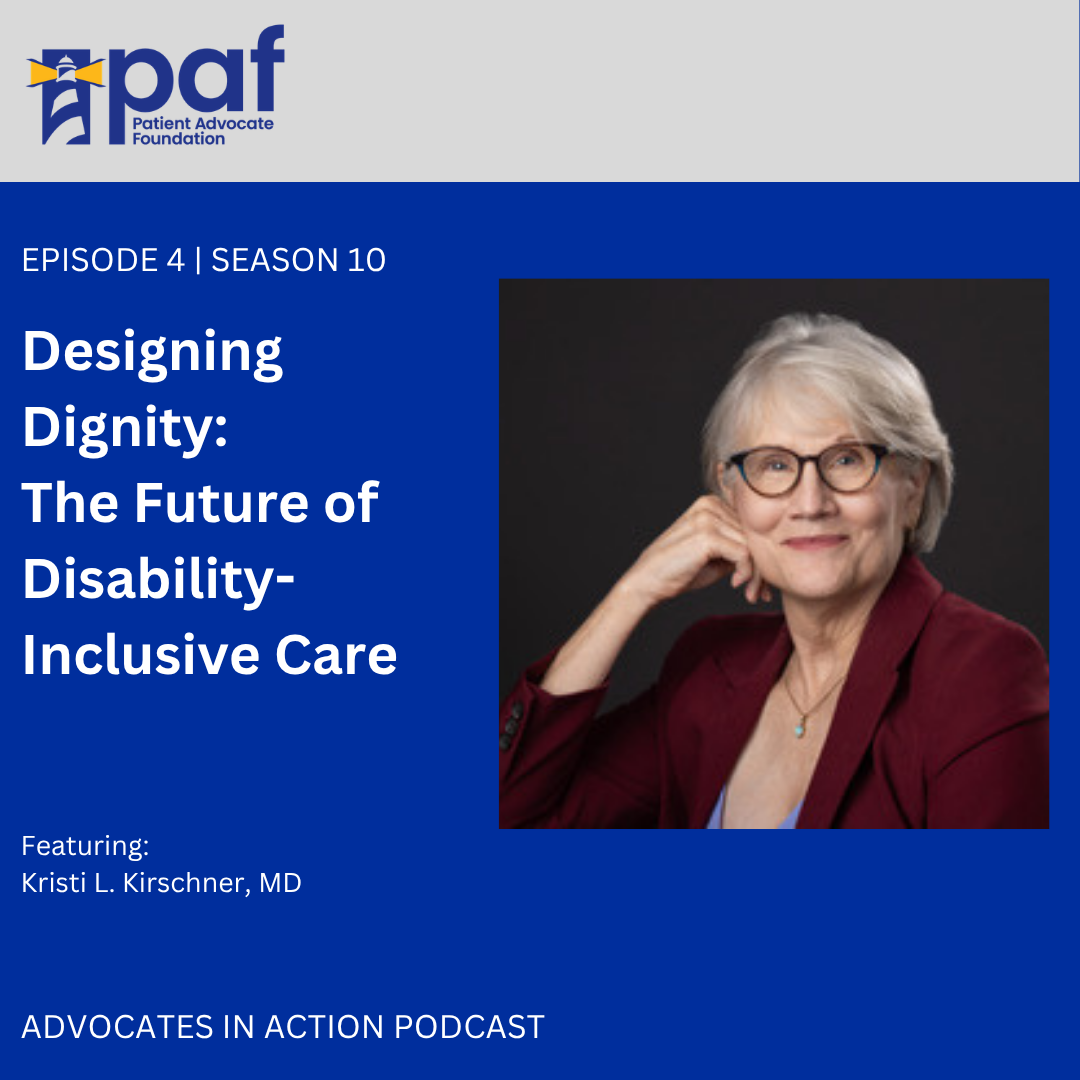
I'm Christy Kirschner. I'm a physician with a special specialization in physical medicine and rehabilitation. It was 1990 when I graduated from my residency and that happened to be the same year that the Americans with Disabilities act passed.
So that's also pertinent to my journey. I worked for over 30 years caring for people with complex neurological disabilities and had a particular interest in people who were born with their disabilities, conditions like spina bifida and cerebral palsy and muscular dystrophies. And when they age into adult care, there weren't many services for them. So I've spent a lot of time thinking about how can we build a healthcare system that really is better equipped to provide the care that these patients need. Currently, I'm not seeing patients I'M working on structural issues because in 2019 I moved to the University of Illinois at Chicago. I've been working on curriculum reform and developing curriculum materials for health professionals around how you care for people with disabilities.
I also did an ethics fellowship back in the 90s and disability and ethics have intersected and been a big part of my career. So we're creating curriculum around that as well and clinical services through the Lifespan Disability Clinic. So I'm doing a lot of mentoring of young clinicians in how to care for this population.
[00:03:49] Speaker B: So with this journey of over 30 years of being in this work in different roles, what are some of the changes that you've seen from that act in 1990 to now where we are in 2026?
[00:04:03] Speaker A: Well, in 1990 we had so much hope that the world was going to change dramatically, that we were going to become accessible, we're going to become user friendly and inclusive. And it's been a disappointment, quite frankly, to watch healthcare, which in many ways, in my opinion has been the laggard when it comes to the Americans with Disabilities Act. I can point to many areas in society which are better.
Transportation services are better, communication access is better. We've got more attention to people with disabilities in the school system. But in health care, a lot didn't change. I began to realize that in health care, people weren't being trained in how to care for this population. They were really rather invisible and the issues weren't at the forefront because with the ada, it's not self executing, meaning nobody was going out and doing surveys and seeing whether people had accessible equipment. When people are sick and they're in need of care, they're vulnerable. They don't want to have an adversarial relationship with their health care. And it takes a long time. So a lot of my career has been spent thinking about, so how can we really incentivize health care to change for reasons beyond the law? The law's the floor. But we want equitable health care. We want safe health care. We want similar quality health care. We want knowledgeable clinicians. And that's a much harder challenge. We are seeing progress. I don't want to leave you with the sense that there hasn't been progress. There has been, but it's slow and it's fits and starts. And we're at a moment in time right now that it wasn't until 2023 that disability was finally recognized as a health disparity population.
That was a long time coming. We started to see some federal dollars flowing to work on disability inequities and disparities.
But now that is being curtailed to some degree. We had some new laws that were upgrading the Section 504 regulations and the Affordable Care Act 1557 regulation.
Lot of uncertainty right now whether they're going to be enforced.
So we're living in a time where, yes, we saw progress.
I'm not sure if it's going to slow down or be curtailed or whether we can continue building on those significant nodal points.
[00:06:49] Speaker B: I can imagine, and you alluded to this, how disheartening it can be, because like you said in 1990, there was so much hope. And then you're in the field, you're in the midst of it, and you're like, this is not how we imagined it to be. But there are amazing people like yourself and organizations that you work with that are continuing this work. So I would love to hear more about the work that you're doing now with the curriculum with systems change, because we know that systems change is really a great foundation to be able to enact more change.
[00:07:23] Speaker A: Yes. And so I'm going to tell you some of the positives now.
Yes, the students that are entering healthcare now, at least in my world, are very eager to learn how to care for this population. They have a very strong sense of social justice and health equity, and they're asking us for this curriculum, and that feels really good. They're seeing that disability is part of life. You know, one in four people at any time have a disability.
And part of what makes it hard is disabilities vary so much. You can have an intellectual disability, you can have a sensory disability, you can have a physical disability, but they're there. And we have to teach people how to see it and how to understand the relationship between a person's impairment or disability and their health conditions.
So the good news again, when I talk about this population of people born with disabilities used to be that many of them didn't survive to adulthood with medical technology. Over 85% are now living to adulthood. And some of them have had dramatic changes in terms of their health outcomes and their longevity and their integration because of change. And that change could be due to medical technologies, but also due to the change in the environment and social attitudes and the kind of equipments and supports that people need to fully participate in society.
So that's all really good news. And part of that good news is that now seeing more health professionals with disabilities entering the field, I think that's critical because, again, if you have equal status relationships, you're working side by side with people who are different than you, you learn so much and so much of the story of our country is a story of great heterogeneity and pluralism.
We're not a small, homogenous country. We're a very large, diverse country.
And when you're in health care and you can work with people as patients from all walks of life, how do you learn what it's like to be somebody very different from yourself? It's not from our imagination.
Oftentimes our imagination gets it wrong. If you look at disability and you ask health professionals, what do you think it'd be like to be that person that happens to have a spinal cord injury? Many health professionals have a very negative idea about the quality of life of disability. But in reality, we're much more negative than the people who live with these conditions.
And there's all sorts of reasons for why that is. But if you're talking to people, you're hearing from them about what their lives are like, you're hearing stories, you're understanding how much is interactional. It's not just intrinsic to the body, but it's how people are supported and treated and what resources they have. Then you begin to change and morph.
So I think that the inclusion of health professionals with disabilities will also cause the health professions to change.
So my work right now, two big projects. One is this lifespan disability clinic. And it became a passion for me because in my 30 years working as a doctor, I felt like I needed an infrastructure. These patients are complex.
You need good social work services and behavioral health services, and you need your equipment specialist, and you need a team of specialists like pulmonologists and urologists and orthopedists. So you've got to have an interprofessional team.
And that's not the way medicine, by and large, is practiced. Still, we keep talking about it and trying to encourage our students to begin to think that way. But the financing of healthcare actually is a problem. It doesn't really incentivize that kind of practice.
So a lot of the things that I felt like I tried to work on and to build actually were the first things of the chopping block when there was a financial concern.
So you might have Medicaid cuts, or you might have changes in Medicaid rates, and all of a sudden, then things that were not revenue producing might be the programs that are cut.
So at this point in my life, I've decided I want to work on structural solutions that could potentially be sustainable.
The University of Illinois Is the public university and healthcare system for the state of Illinois I think is the right place to be trying to develop these resources. We have seven health science schools, so we train nurses and social workers and doctors and allied health professionals. So we've got this dental care, We've got all of these people as part of our health care system. A lot of people who we can touch through training.
We also have the Department of Disability and Human Development.
This is an important historical and cultural piece.
In the 60s, people with disabilities began their civil rights movement and that was part of the Americans with Disabilities act.
Culmination in 1990, you had people saying we shouldn't be institutionalized or hidden in the back room. We want to participate.
And so you begin to have people with disabilities creating civil actions. There was a sit in in San Francisco for a month to try to get the Rehab Act 504 actually implemented.
You had this group called ADAPT that was pushing the transportation systems, the buses to become accessible. And so there was an empowerment of people with disabilities. And it did begin to change the paradigm.
And so you see over time that there is a much stronger voice and call to be treated as fully included, fully equal in terms of rights.
And I think that culmination was part of what became the social model of disability and disability studies.
So people with disabilities looked at health professionals and said, you're not really helping us.
Many times you see, the problem is me, that you have to fix my body, that you have to normalize my body. That's not where the problem is. I can feel perfectly fine in my body.
It's how I'm treated.
So that became defined as the social model of disability, that disability is interactional. And the medical model was seeing disability as a deficit intrinsic to the body. And healthcare was supposed to fix that body.
It's neither. Those are caricatures.
It's neither one or the other. It's a blending.
So people who live with chronic pain have a problem with their body and no matter how much I change the environment, it's not going to help them deal with their symptoms.
So we got to bring it together and say it's both. And we have to take that holistic look. So after 30 plus years, we've got now these movements coming together and acknowledging that we need each other and that we have to work together. And that's a lot of what we're doing at University of Illinois in terms of trying to create a holistic model for health professionals to understand what is disability and what is your role as a health professional. Your role may be to help that person get on a waiver program so they can get personal assistance services that many doctors haven't learned how to do, that they don't know how to order a wheelchair. I always say a complex, customized wheelchair is the most important prescription I ever write. You're not taught that in medical school.
So we're trying to change the sense of what does it mean to have a disability and what are the different kinds of solutions? Because healthcare still controls a lot of those solutions, even though you're not taught how to do it.
So that's the healthcare piece, and the second piece is this curriculum. And we did apply for a grant from the Health Resource Service Administration to actually create curriculum.
And we're halfway through our grant. I'd love to have you all get on our website and look at the curriculum. It's adih uic.edu, and that stands for Advancing Disability Inclusive Health Care.
And this curriculum is going to be growing still over the next two years.
We've got online modules, we've got stories so people can log on, take the modules.
We're trying to develop it so it can be used by the widest number of people. So just sign onto the website and explore it and decide if you want to take the curriculum yourself or if you, as a teacher, would want to use it in training your students. We're developing standardized patients or patient instructors who are training our students and giving them feedback. So these are people with disabilities who are taught to enact a clinical scenario.
I've got this cough or I've got this burning when I urinate.
Otherwise they bring their whole self to the encounter. So we're not asking them to pretend to be anybody other than they are. They just describe this clinical symptom and what's going on.
And then when they give feedback to the trainee, they're talking from their authentic experience.
What do I want you, as my potential doctor or nurse or social worker, to know about what I want from my health care? What kind of relationship? Most patients are going to say, I want to be a partner. I don't expect you to know everything about me or my disability, but I want you to be open to hearing what is of concern to me. I want you to ask me if I need to get onto that examination table. Ask me, how would you recommend we do this?
So I think developing communication strategies and partnerships is a lot of what we're focusing on in our training materials.
[00:18:42] Speaker B: And we'll also include links in the show notes as well for people to have Easy access to it. I loved what you mentioned about the communication strategies and the example that you used about getting onto the examination table. The language that you used was how would you suggest that we do that? So really approaching the conversation with, with curiosity and asking your patient, because your patient does know best and they know their body best, what they're able to do, what they're not able to do, what feels more comfortable, what doesn't feel more comfortable. So that truly showed me that example of what true partnership is. And earlier when you were talking about the history so sit ins in San Francisco and the civil rights movement focused on people who are living with disabilities. It sits seem like self advocacy was a huge part and driving factor back then as well as now. So what are some characteristics that you've either seen and experienced with your patients over the years or now as you're creating curriculum and teaching students and teachers how to navigate best with patients? What are those characteristics that people who are living with disabilities bring to the table that need to be more respected and more honored?
[00:20:00] Speaker A: Yeah, I think first of all, there's a lot of ableism in society and ableism is that we think it's better to be not disabled than disabled. We think quality of life is better if you're not disabled than if you're disabled. There's a hierarchy and the world is built for people who are not disabled.
So I think that we have to recognize from the moment we're interacting with somebody, we need to understand that how we treat them has a lot to do with their own internalized sense of self.
If we give them subliminal messages that you don't belong here, we didn't see you, we don't plan for you in our spaces, then they can develop what we call internalized stabilism.
They may feel like they're broken, they're bad, they're a burden. Right. So a lot of the work, I think, in health care is to try to give the person the message that you may have a disability, but you belong here, you have a right to be here and you need to know what your rights are and how to advocate for them.
So there's a whole educational piece about knowing what your rights are, knowing how to navigate the healthcare system, system. Again, we don't want adversarial relationships. We want people to work in partnership and to be able to offer solutions.
So one of the things that we really try to encourage patients to do is when they call to schedule an appointment, tell the scheduler what your needs are.
I need extra Time. I need a high load table. I need assistance in transferring. If you're going to need a urine specimen, I will need an accessible bathroom.
Just tell them what you're going to need because you want to plan for the visit that will be successful for you as well as for the health professional. There's some coaching I think that we can do to help people have better healthcare experiences, but then to also have health professionals understand that you have to understand what it's like to live with a disability and understand that if that person is 10 minutes late to their appointment and they rely upon transportation services that are not 100% reliable.
I used to, when I started practice, talk to my patients about how did they plan to get to the appointment.
Many patients had to get up at 6am the day before and call and call and call and call until they got through on this line to schedule their appointment.
Sometimes the slots for the time that they wanted were already full, so they'd have to go earlier.
Some patients would take an entire day to get to their appointment and wait for the ride at the end of the day.
If you've got a cancellations policy that if you're 10 minutes late or 15 minutes, you have to reschedule, that's not reasonable. That person has made a huge effort to get to you, get to see you. So I think this idea of being able to articulate if something is not equitable in the healthcare system, if something is not working, just state in a way that people can understand why that's not fair, that's not just, it's not kind, it's not good quality care and try to tell them what it is you need. I do think most people in healthcare actually do want to provide good care and they want to have good relationships with their patients.
Many are very stressed because of a lot of stresses coming down on them from administrators and from their employers.
So part of it is to just say, let's have compassion and grace for each other and try to set things up for success as much as we can.
[00:24:11] Speaker B: The empowerment of the patient to vocalize those needs and also for providers and people who schedulers to ask those questions as well, instead of assuming that everyone's coming in with the same amount of needs and like you said, making sure that people feel like every encounter that they walk into, like, hey, this was prepared with me in mind and the things that matter the most to me as well. And so. But what are some changes that you've seen in healthcare that are impacting people who are living with disabilities? And what do you hope to see in 2026 to be able to provide solutions for those?
[00:24:55] Speaker A: The Medicaid cuts are of great concern.
Our patients are disproportionately users of Medicaid and they rely upon waiver services which are paid for through Medicaid.
Now, our country does not really have a long term care infrastructure.
So if you need personal care services, it may be a family member providing it, maybe somebody quitting their job to stay home and care for you.
A waiver service is a mechanism to get paid personal assistance through this Medicaid program to allow people to not be in institutions or nursing homes, but to live in the home and community. It's a huge benefit to all of us.
It's a lot less expensive.
Medicaid is only required to do nursing homes and institutionalizations.
So again, when you look at what's going to be cut, where are we going to feel the tightening belt? I worry a lot about Medicaid and waiver services because these are so important for our patients and they're a long waiting list already.
If a person has an intellectual or developmental disability, they may want to live in a small group home or attend a day program. You, you can be on a waiting list for years to be able to get accepted into that program.
All the while you've got aging parents who have their own health care needs.
And there needs to be planning for the future. As I mentioned, people are living much longer than previously. We need to have a plan.
So I worry a lot about are the funds that people need going to be available? Because we have made a lot of progress and we realize that the possibilities are vast.
But rather than cuts, we need more.
So when somebody ages out of pediatric care, we talk about a cliff.
They no longer have the enhanced benefits of the pediatric care system, they no longer have the school system.
And oftentimes when they turn 18 or in some states, 21, the infrastructure to support people's lives isn't there. Or you have to reapply and be on these waiting lists. And that's a very difficult time for people because they were in school or they were in programs, or they were engaged and all of a sudden things come to a screeching halt.
A lot of the work we hope for is to recognize that people have all sorts of capabilities.
Somebody may not be able to be employed full time with gainful employment, but maybe they could be employed part time. Maybe they could work from home, maybe they could volunteer as a way of participating. We've got these catch 22s that people end up experiencing where if they make too much money, they may lose their personal assistance services.
And we've tried with policy to fix some of those, but it's still a big problem.
So rather than lose benefits, we've wanted to continue to address these problems and enhance them. Not sure it's going to be possible in the current climate. The other thing that's happened, and we've seen this with the signaling that the Department of Education is going to close, you've got offices of civil rights that take care of complaints problems, special education schools not providing services and resources that were embedded in the individual education plan.
So I think that's going to have a huge impact too. We're not holding people accountable for what they're supposed to be doing. When we cut back on those civil
[00:29:08] Speaker B: rights programs, with all the knowledge of all of these challenges and the difficulties and the twists and turns and things being cut left and right, one thing that we, we do know is that there are still amazing organizations and people who are out here fighting for health equity and for equitable access for people who are living with disabilities.
So what are some organizations or people or resources that you would love to suggest for our listeners to look up or ways that they can be a part? I know we talked about the curriculum being open for anyone to be able to access, but what are some other ways people can get plugged in and be a part of the solution?
[00:29:54] Speaker A: Well, I want people to be aware that there are independently living centers all across this country.
And these are not residential. These are programs run by and for people with disabilities.
They have services to help people understand what a personal assistant is. How do you get one?
If you need to learn how to instruct the person in how you want your body handled, these are relationships that require some care and emotional intelligence because people are oftentimes doing personal intimate care, working with personal assistance services, getting your transportation benefits, working on getting the school iep, having peer support groups, looking at transitioning into your own home potentially in the future.
So independent living centers have been a very important part of this story.
The American Community Living Division of our government has overseen them. And again, that's something that's changing. But so far they're still in existence and they are places we can go. If you're a person with a disability or a family member who has a family member with a disability, they provide services and supports and resources that are very valuable. We do have a lot of disabilities. Specific organizations like the Spina Bifida association and United Cerebral Palsy and the Muscular Dystrophy association, all of them have a different slant in terms of their focus and what they provide, but they're very good organizations to partner with. When you're in health care, you are supposed to have an ADA or Disability Rights Coordinator that you can reach out to and contact and ask questions of. I'm coming into the hospital and I had difficulty getting an accessible call light. You can imagine you can't use your hands and you're stuck in a hospital bed. How would you call for assistance? So working with the internal structures and supports is also part of how we can help with culture change.
We're a very large country and disability is a large swath of the population, but it's heterogeneous. The needs of a person that's deaf and hard of hearing will be very different than your older adult with Alzheimer's disease. So we have to have sort of principles, but we also have to have a lens that looks at the special needs of different groups. Society is also saying that disability is not just a quote unquote problem. It's an opportunity to look at the world differently. A lot of the creative solutions to problems actually come from people with disabilities, and we've certainly seen that in technology. If you look at voice activated software, where did that come from?
You know, and then all of a sudden, we all love it, we all want to use it.
When you look at doors with sensors that open and close, or you look at curb cuts, well, gosh, if I'm pushing a stroller, that benefits me, right? Embracing disability as a creative lens, problem solving lens to look at the world. There's this concept that I love called universal design.
Let's look at the world and try to build it to be inclusive for the widest swath of people.
We have to think outside of the box, and people with disabilities are used to doing that. And they can help us all elevate society and the way we do things. Because if we live long enough, we're all going to be disabled. It's just a fact.
And we're all interdependent. We may want to believe that we're independent and we don't need anybody, but we all will. It's just a fact of life. And interdependence is actually a beautiful thing when you realize, I right now don't need help dressing and bathing, but boy, do I require an electric grid and hospitals and highway systems and a food supply.
There's nothing I do in my life that I'm independent with. Everything is interrelated So I think we would do much better if we just looked at that and acknowledged that and appreciated that that's his strength.
[00:34:29] Speaker B: I'm Ashley Freeman and thanks for listening to this episode of Advocates in Action. If you haven't yet, please subscribe, review and share this podcast. Your support is greatly appreciated. We enjoy connecting with our listeners, so please visit our website for show notes, resources and ways to engage with us on social media. Thanks for listening.