Episode Transcript
[00:00:03] Speaker A: So often what happens in these scenarios is the academics. We're just socialized to think about our career and our success over that of the community or those that we're partnering with. And normally the framework is you do research on community, which is a very traditional way of thinking of research. Our team is all about like we build the capacity of the community to think through what research needs to be done and then we do it together because I'm a leader in which it's shared decision making and so I'm not going to override what our team thinks.
[00:00:34] Speaker B: Welcome to another episode of Advocates in Action, a podcast created by the Patient Advocate Foundation, a nonprofit that helps promote equitable access to affordable, quality health care through providing case management services, financial assistance, and patient education and advocacy tools to people living with chronic, life threatening and debilitating illnesses.
I'm your host, Ashley Freeman, manager of stakeholder outreach and engagement. And welcome to season 10 where we get the opportunity to discuss what happens to patient care when equity and inclusion in health care are under threat. I'll be joined by some guests who can provide some hope to the troubling trends we are witnessing, including shifts in health policy, reduction of funding, limits on research priorities, and changes in clinical practices that threaten to dismantle hard earned gains in health equity. Thank you so much, Dr. Ann Cheney for being here this season where we are focused on health equity. So I would love to hear first from you about the partnership and the organization that you work.
[00:01:49] Speaker A: Thanks Ashley. I'm really happy to be here.
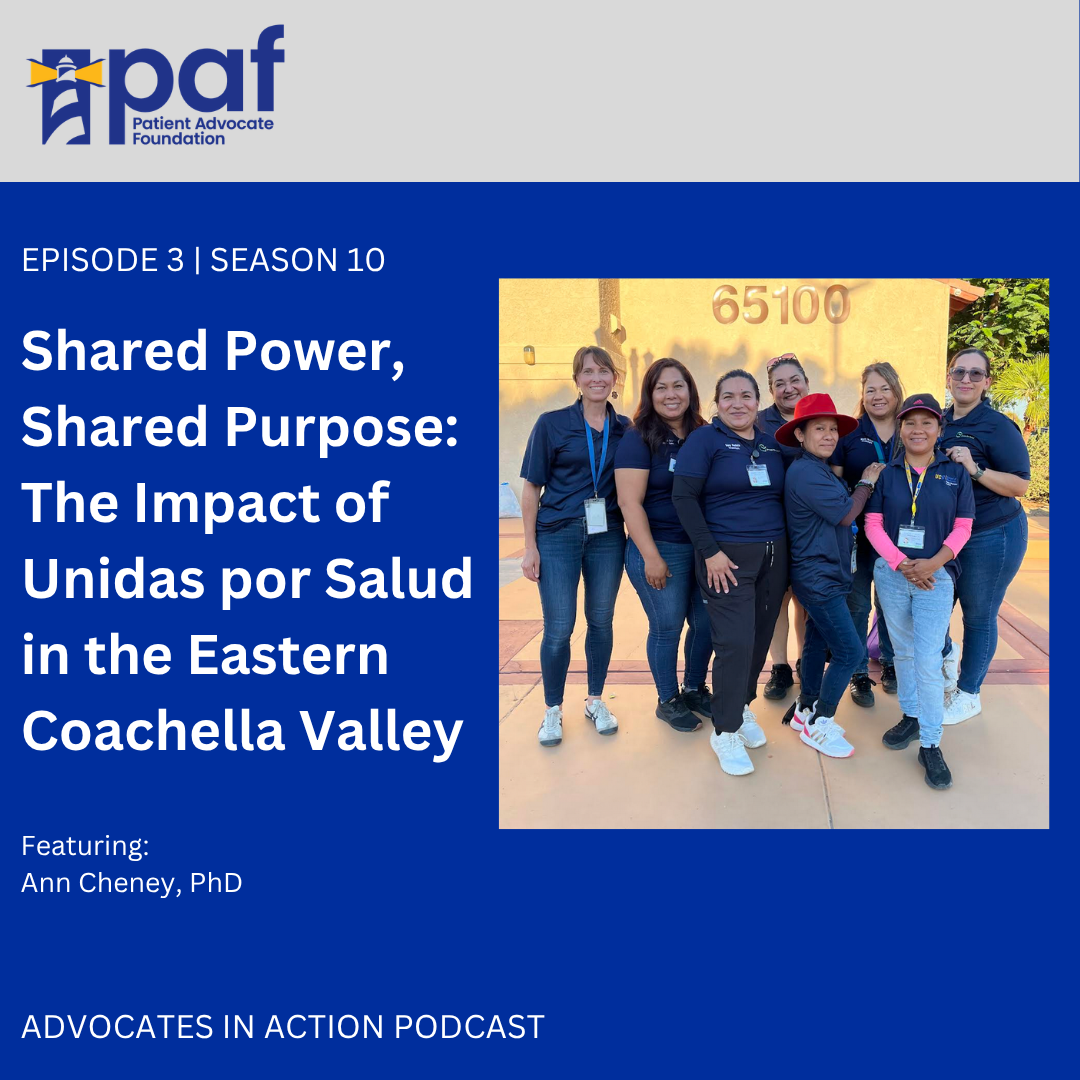
So my team is referred to as Unidas por Salud. This is a community academic partnership that we established in 2017 and it was born out of a partnership between myself as the academic investigator and Maria Conchita Pozard, who is the community investigator. And it started with original funding to be able to do a very small community health needs assessment. Both myself and Maria were pretty new to the idea of community based participatory research.
But, but I think that that approach which is about shared leadership, shared decision making, resource allocation, co design of studies that that really fit very well with how we approach things. So we've been incredibly successful and we now have six promotores which are community health workers who are part of Unidas Porcelur, our team and then we have numerous students who are also part of the training so supporting the projects that we do which include research as well as well as healthcare service delivery. And I should say that Unidas por Salud is strategic. The naming Unidas refers to women United So women who are united for health and why that's important is because we're an all women led leadership team. We really focus on empowerment of women women leaders.
When we think about our community health workers, our promotores, they are leaders of their community, they are from the community, they are from their own respective community, and they represent the voice and the experiences of those in their communities. And then we also really privilege and highlight the work of women of color who are scholars within medical education or other programs at our university.
[00:03:38] Speaker B: And where was the inception of this idea? Where did it come from?
[00:03:42] Speaker A: I'm an anthropologist by training. When I moved to UC Riverside for my position in 2015, I really wanted to find a location to do research. And as an anthropologist, we think about it as identifying a field site, meaning a place where I can really develop relationships with community members, work with them to identify community health needs, and then build a research agenda around those needs. Part of my training was to think like that. And then I just happened to be hired into a center that was focused on community based participatory research, which is really an approach that's embedded within public health health services.
It's a way of thinking through how can we make interventions or how can we make research meaningful to communities or patient stakeholder populations? When I came here, I really wanted to find that community and also those partners. And I was connected to Maria Conchita Posad in my second year of being here. And we just essentially took the leap of faith to partner together.
And it led to a number of many great things.
[00:04:52] Speaker B: Here you are, years later, making such an amazing impact.
And for people who aren't familiar with the area that you all service, can you paint a picture of the health landscape of people that live in that area? What are some of the health inequities that they're facing, and what are some of the problems that your organization and partnership aim to solve?
[00:05:15] Speaker A: So we primarily do work in the eastern Coachella Valley, which is located in inland Southern California. When we think of inland Southern California, it's an incredibly large, vast area that includes very large rural pockets.
And the area where we do work is in the rural region of what's referred to as the Coachella Valley. It's the eastern rural part. The Coachella valley is about 45 miles long, and it is a really fascinating place. Many people may have heard of it because there is Coachella Fest. There's also Palm Springs, which is an area really known for tourism and for beautiful golf courses. Mind you, this is in the desert so on the western part, it's very affluent. The per household income is over $100,000. And it's primarily individuals who may identify as white Euro American. There's a lot of snowbirds, so individual who are coming from Europe or Canada or other areas in the US to spend their winters in a warmer climate. So it tends to be an older population, at least the far pockets of the western valley, whereas the eastern part, where my team does their work and where my team, aside from myself, live, it is primarily Latinx and indigenous Mexican immigrants, many of whom are earning 25,000 or less per year, and they're working in the fields. So there's a very, very stark contrast between these two parts of the valley.
And the eastern valley is right next to the Salton Sea, which is the largest lake within California. But over the years, because of water politics around the flow of the Colorado river, as well as climate change, with increased heat, the sea has shrunk significantly, and the main source of water is agricultural runoff. For decades, agricultural runoff has really been a significant source of water into the sea. But now, because there is no new freshwater coming in from the Colorado river, it's shrinking even greater. As it shrinks, the playa is exposed, and the chemicals from agricultural runoff and other chemicals, they've seeped into the lake bed. And so now that lake bed is exposed and it's the desert. There's a lot of windstorms that blow sand into the air. And some of the work that we've done is in collaboration with an atmospheric physicist who looks at wind patterns and looks at the transport of toxic dust into people's homes. And so people are breathing, and it's primarily more vulnerable groups that are affected, which includes children or older persons. So in terms of thinking about the health landscape, there are significant health disparities within this population, particularly around chronic disease burden, asthma among children, and other respiratory health problems. And then among adult populations, there's very high rates of obesity, type 2 diabetes, and hypertension. And then there's limited access to healthcare services.
[00:08:24] Speaker B: So with that context laid and painting that picture for us, what are some of the services or programs that Unidas por Salud provides to be able to address these issues that are being seen with asthma in children and hypertension within adults? What does that look like?
[00:08:45] Speaker A: Our base is research.
And for research, we've had funded many different research projects, primarily funding from pcori Patient Centered Outcomes Research Institute, as well as nih, National Institutes of Health, and various institutes within nih. And then we've received Some foundation grants, but primarily PCORI and nih. So our primary goal is to build evidence that can be used for advocacy. And when we generate that evidence, we learn about what is locally needed that also has implications for also regional and national or even global health implications.
What we have developed from our research has been essentially different pathway programs.
So one pathway program that we have, we really have recognized that there's a lack of bilingual English and Spanish healthcare providers, specifically physicians. And because I am at a medical school and I work with medical students, one of the first things that our team did in collaboration after we did our original needs assessment and we were understanding all of these barriers to healthcare access, one of which was lack of bilingual healthcare providers, is we built on a program that was already existing in the medical school, but it was student led and it was focused on increasing students vocabulary in Spanish within medical context. Then I worked with my team to figure out, well, how can we have this be more centered on what physicians would need to treat the patient population in our area, particularly in inland Southern California and then specifically the eastern Coachella Valley, which has an incredibly large Spanish speaking patient population. But it's not just about the language. It's also about understanding the cultural nuances, norms, as well as the inequities that shape health care access and the inequities that might increase risk for chronic disease burden. So we created our medical Spanish curriculum which is referred to as a blamos. It's Hispanic and bilingual longitudinal ambulatory medical studies, very long title. So we use the acronym hablamos and that curriculum is implemented now within our medical school. We can share this curriculum as well with physicians in training, which is residents. But it focuses on connecting the students not only to learning within a textbook and increasing their vocabulary, understanding the grammar, but connecting them to our team of promotoras and to others within the patient population that our team serves, which is patients in the eastern Coachella Valley, a very low income, low health literacy. So that's one example of ways that we've been able to build on our research to create programming that can address some of the inequities we see.
[00:11:36] Speaker B: That's amazing. And is this curriculum able to be adapted at other schools as well?
[00:11:43] Speaker A: It definitely can be. We haven't yet had another school who has basically taken the curriculum and adapted it. But we have been in conversation with faculty at different medical schools and we've had lots of conversations with students who are really interested in having this curriculum at their own university. I think the challenge is you have to find Someone who has relationships like to have it really be about how do we connect, how do we engage the community in the process of learning the language, and not just the language, but learning about the needs of, of a patient population that historically and currently is marginalized. That takes a unique skill set. And I think that why we've been so successful is because I have a background in anthropology and so I'm able to bring these differing perspectives into the learning environment.
[00:12:32] Speaker B: What type of feedback do you see from one? The students who are getting this unique type of experience that most other medical schools don't have, but as well as the patients that you serve. We throw these terms around shared decision making and making sure that patients are at the center. But what you're explaining is a real tangible example. So what type of feedback have you received from both ends of those spectrums?
[00:12:59] Speaker A: Really positive feedback. I've noticed that over time the students who I mentor, the students who are part of our BLAMOS program, and I didn't mention, we also have the Coachella Valley Free Clinic, which is a clinic that was born out of the initial needs assessment that I mentioned in the beginning of our conversation. This is a student led free clinic. It's primary and co located mental health care services, all volunteer based. At different times, based on our partnerships, we have other service providers like we have an ophthalmologist who comes to half the clinics we provide each year. We also have pretty consistently an acupuncturist and a chiropractor. We also, as I mentioned, mental health therapy, a kids room and then we partner with a number of different community based organizations.
And those community based organizations bring resources as well as healthcare systems in the region. There's overlap between these two programs. We require the students who are in the ABLAMOS curriculum and that programming, we require them to come to the clinic. And so in the first year of the program, they are expected at least once during their first academic year to come to the clinic. And this is so they can practice Spanish, but also get a sense of the patient population in the region. There have been many times when I've talked to medical students, students who are at ucr. They're only an hour and a half from this area, this patient population. But some of them have never been there. They've never heard of the eastern Coachella Valley. They've heard of Coachella, but they haven't heard what's east of Coachella.
So I'm pretty amazed that some of our students, they become really passionate and it's an Opportunity for them to practice their language skills, to develop leadership within the context of serving underserved patient populations and those who are really interested in considering a research path. As a physician, I provide mentorship to those students who carry out research in collaboration with our promotoras in the context of our clinic.
[00:15:00] Speaker B: Are there opportunities for these students afterwards to be able to stay in the community and continue to work, or what does that look like? Because I know you just mentioned they become very passionate about this work.
So where do they go next with that passion, with that knowledge, with that experience that is very unique to attending this program?
[00:15:22] Speaker A: So I'll answer that by first giving context about how long I've been at UCR in my current position. So I've been here since 2015, and I think I really started mentoring students More so in 2017, 2018. So only now are the students who I've mentored coming back.
That's because after they complete their four years in medical school, they then go on to their residency programs. So right now, for example, I had a text message from a former student. She is now a physician resident who is building on some of the work that we did together. She was part of a project that we had around creating a cookbook we refer to as Ancestral Recipes. And the cookbook is designed around Mesoamerican food traditions that are very common in the prepache community, which is an indigenous community community from Michigan, Mexico, that we collaborate with. Our community partner is from part of that community, and so she is giving a talk with some other physician residents that's focused on the work that we began around Ancestral Recipes. So essentially ancestral food ways and traditions for healthy eating among the Latino community, such as one example that's more recent, other former mentees have contacted me to say, you know, can we continue to collaborate? Is there a way that I could continue to work with your team on research projects? The challenge of returning to that area to serve the patient population is there's very few health care systems and there's no residency programs that are immediately in the community where the patient population is, because it's a very rural area, and academic medical centers are often more urban suburban areas. I have some mentees who are now at Eisenhower Health, which is about 60 minutes from the patient population. And so we're now in the process of engaging them in conversations and having them come out to our clinic to serve as preceptors to our medical students.
[00:17:17] Speaker B: That's amazing and a beautiful full circle moment for the students as well as for yourself. And when we began the conversation you talked about. Shared leadership is at the center of this partnership and co design.
So what does that look like between the community partners and your academic setting? Showing up to be able to have this shared decision making when maybe priorities or perspectives or the lens or the experience that you all are bringing to the table might be so vastly different.
[00:17:51] Speaker A: Over time we've recognized what our strengths are. So for example, as the academic partner and the students that I bring, or program coordinators that we can hire through grants that are embedded within the School of Medicine and the University, we recognize that our strength is in one, being able to submit the applic to get funding for a project because that requires writing a submission in English. It also requires navigating these platforms that sometimes are very difficult to navigate in the support services that we have around us for grant administration and then the use of technology. Our students are really clever and they're much better at the use of technology than I am. So whenever we have to do something collaboratively as a team, for example data analysis, we try to use community friendly platforms, but we assign a student always to help the promotora so that we ensure that there's access and that there's the ability to problem solve. When we hold any type of research or any type of public health talk on Zoom, we make sure that we have a student there or a staff member who can figure out how to do all of the technology. And then when we think about the community, their expertise is in engaging community and building trust in research, in medicine, in science. We work with a very, very disenfranchised community who lives in the 100 mile US Mexico border region. And so that means that there's an additional layer of distrust and fear of outsiders. And you know, I'm a white woman and I'm an outsider. I speak Spanish, but you can tell that I have an accent. I'm not Mexican. And so I am absolutely an outsider. My recognizes that they're superb in being able to build trust and be the face of the work that we do.
[00:19:43] Speaker B: That honor and respect for the different skill sets you both bring and acknowledging that you are an outsider. So many white people miss that component. I remember in a previous podcast speaking to a researcher and she said that the key thing to her work is remembering that she is only able to partner with the community by invitation only. She understands it's a privilege for that type of trust to be granted to her.
So for you, what has this experience taught you about leadership? In order to build something truly community driven and Collaborative like this.
[00:20:24] Speaker A: I learned a lot about leadership over the years.
I have in my bones this idea of collaborative and horizontal leadership. And that works really well. It works really well on a team in which we're all women and where we can openly talk about what we like or don't like and not become offended and to really give space to other people so that they can voice their opinion. My community collaborator, we've built such trust in our leadership and our communication with each other that she's not afraid to say to me, I'm not in agreement. So, for example, just recently we have this partnership and the plan was to collect blood samples. And we've had a bad experience in the past with collecting blood samples as a biomarker for research. And so she flat out said, like, no, we're not going to do it. I don't know this new investigator. She seems nice, but I'm not at the point where I trust that other group to come in. If I were a more traditional type of academic, I might say, well, it's really important for the research. But I just left as, yeah, you're right, we shouldn't do that because we. We haven't really been able to build confidence and trust in doing that. And we did it wrong. Last time we had a bad experience in which we partnered with a clinical collaborator and the funding and the project was led by our team. But there was a component in which we collect biomarkers, and it was the first time that we ever committed or said that we would ask community if they would be willing to do blood draws. And it didn't go well.
One, because we didn't have the right phlebotomist. And then two, the data, the blood samples were actually prepared for an analysis that the participants did not consent to. And fortunately, there was a whistleblower who shared this information with our team, and then we had to stop the process.
[00:22:17] Speaker B: In those scenarios, you prioritize what mattered the most to your community partner as opposed to your clinical partner.
I imagine being in the middle of that situation isn't easy, though. What type of position does that put you in?
[00:22:33] Speaker A: It puts me in a very difficult position, but because I'm a leader in which it's shared decision making. And so I'm not going to override what our team thinks. In that situation. In particular, it was very difficult because there was a lot of pushback and saying, well, you know, you just go back to the community and ask them to reconsent. And that just wasn't an option. And I wasn't going to pursue that. What that resulted in is the end of that partnership, the loss of data for us to be able to move forward any analyses that would have been related to the blood samples, which was to obtain hemoglobin A1C levels, which was really important in terms of identifying if our intervention had an impact at a biological level. But we didn't have the right things set into place and the right partners. And then it also meant that we decided we would end the partnership and not receive any more funding. So it's a loss in terms of monies that we could have received. And that's happened twice. Not the biomarkers, the blood sample, but twice in the sense of our team has decided we're not going to partner with that group or that person because of their lack of professional ethics. At least when it comes to working with underserved patient populations, that loss of
[00:23:46] Speaker B: money is worth it, you know.
[00:23:49] Speaker A: Yep.
[00:23:52] Speaker B: Especially if you can't respect and understand the boundaries and safety needs of the community.
Because I'm sure there were other alternative paths the clinical partners could have tried. But that lack of willingness to find some sort of middle ground that honors the needs of the community shows, hey, this actually isn't a partnership that is equally yoked and meant to happen.
[00:24:21] Speaker A: So often what happens in these scenarios is the academic.
We're just socialized to think about our career and our success over that of the community or those that we're partnering with. And normally the framework is you do research on community, which is a very traditional way of thinking of research. Our team is all about like, we build the capacity of the community to think through what research needs to be done and then we do it together.
[00:24:44] Speaker B: I love that. True collaboration, true partnership.
And over this past year, with many things that changing health policy wise and attacks on health equity and attacks on our most vulnerable populations, has that impacted the work that you all do at all? Or have you all been able to continue your mission and your work in spite of everything that's happening?
[00:25:08] Speaker A: So it definitely has affected us. So it's affected us in thinking through in the very beginning with the change in administration, should we continue to engage in research or should we just shift our focus so that we're providing a service to the populations that we engage in our work? And while we, I don't think, made very like concrete firm decisions, what I have noticed over the past year is that we've shifted more. So we're focusing on our pathway programs, we're focusing on the services that we provide through The Coachella Valley Free Clinic. In January, there was a increase in ICE raids in the community in the eastern valley with a focus on farm workers. And some of the students noticed who were taking vitals, that the patients had elevated vitals. And when they talked to the patients indicating what their vitals were, they were learning that some were choosing not to exit their home because of fear of ice and that they weren't going to the grocery store. They were only leaving to go to their work if they had to. And so we talked to our team of community health workers promotores, and we asked them a little bit more about what's going on. And so they explained to us exactly what I just mentioned, that people were terrified and obviously that stress was affecting them. And also they. They didn't have money to go and get food. Some of them weren't going to work. So our students, in collaboration, like under my supervision and our community investigator, were able to do a campaign to raise funds to get food and to create food boxes that they then delivered to our patient population, which they were able to deliver, I think, over 30 food boxes to families in need.
[00:26:47] Speaker B: That is a beautiful example of identifying the needs of the community and executing a plan to address it. Even though it's outside of the typical scope of the work that you all are there to do.
You understand your patients can't prioritize being healthy and well when their safety and their livelihood are being threatened. So, truly looking at your patients holistically and holding space for the reality of the structural and social and political determinants of health that are impacting them. And in the midst of all of this heaviness, what gives you and your team hope during this season?
[00:27:29] Speaker A: It's the students that they will come back years later and say, hey, Dr. Cheney, what can I do to support the work that you and your team's doing? Or the students who, while they're in training, will say, you know what, I really want to get this grant because I want to bring more services, more resources to the clinic, or, you know, I really want to start developing some research, because I'm seeing that this is what's going on with this patient population. And so I know that even after I have moved on to retirement, as well as my community collaborator, that there will be the capacity of younger generations, younger scholars who are dedicated to this patient population. I'm just amazed at the passion that I see among my mentees and the students that are part of. Of the different organizations that we have, whether it be the clinic or our medical Spanish curriculum. I think that's my hope.
[00:28:24] Speaker B: I'm Ashley Freeman and thanks for listening to this episode of Advocates in Action. If you haven't yet, please subscribe, review and share this podcast. Your support is greatly appreciated. We enjoy connecting with our listeners, so please visit our website for show notes, resources and ways to engage with us on social media. Thanks for listening.